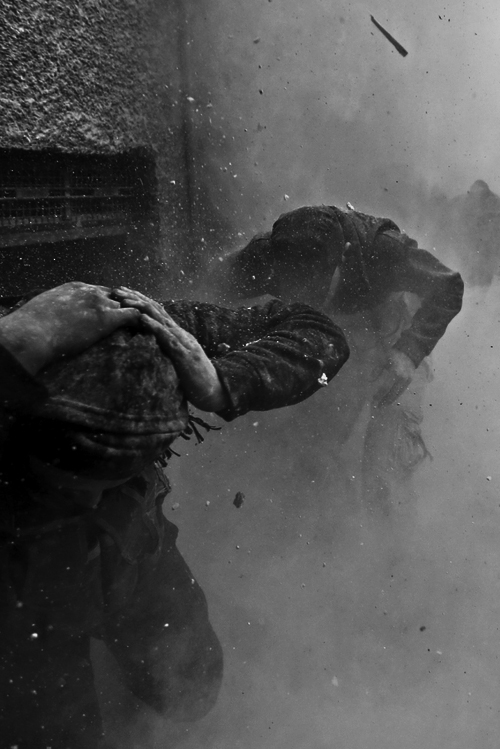
Young Paris - "WATAH". Plummeting clouds. They land in the street like cinderblocks. They thud onto roofs, clang onto driveways, hit fences at an angle and spin out into dust. People are hit - right in the head, bloodened and blinded by heavy falling clouds. Sirens ring. Children cower in windows. What is going on, that clouds plummet, heavy? What is going on here exactly? Pundits will say that there's an issue with evaporation, precipitates, additives in the water. Nobody considers that this might simply be a choice: stony heaviness, undeliberate, the universe in an unwittingly good mood. [bandcamp]
---
Other business:
Please don't miss Dan's ridiculous, brilliant webseries announcement from earlier this week.
A handful of Us Conductors events in Canada this week: - MONTREAL
- VANCOUVER
- VICTORIA, BC
- NANAIMO, BC
Hope to see you there!
Pillar Point - "Curious of You". Scott Reitherman, of the splendid and underrated Throw Me The Statue, returns as Pillar Point. Pillar Point's a record all surging and rattling, skateboard and skyscraper, a river meeting the sea. "Curious of You" gestures to Cyndi Lauper and Phil Collins; it sizzles; it slides. It's about sleep and curiosity, wanting and having. It's a song of pairs, thises and thats, sounds in mirror repeat. Sometimes an echo's just fading reverb, sometimes it's a twin. Sometimes you're the same man, in dream, that you are when you're awake. [buy]
Eternal Summers - "Not For This One". Eternal Summers' Nicole Yun cedes the mic to drummer Daniel Cundiff. But she's still on guitar, still singing with her guitar, laying down a solo that's as wistful and wintry as his vocals, that's every bit as perfect, both of them hastened by the pace of the drums. Those drums: something in their neat pulse, in the shape of the snares' decay, recalls the hiss of cassette tape. It's the right match for the guitars' C86 jangle, like the sound of a garage pop band slipping just out of phase. [buy]
(photo by Goran Tomasevic)
12:44 AM on Apr 29, 2014.

Alexis Zoumbas - "Tzamara Arvanitiko". The man became rich with his crying violin. He took the instrument from hall to hall, from town to town, showing its weeping to the people. He cradled it in his hands, bowed and plucked, and everybody wept great silver tears. They piled money into his arms, gave him luxurious gifts and held huge dinners. They recited speeches in honour of the man with the crying violin. They called him a hero. He lived in a huge apartment in the city, with oils on the walls and cabinets full of jewelled samovars. He was happy.
And then one year there was another man, a stranger, who came to these lands with a different violin. His violin could also cry. Perhaps not as well as the first man's crying violin, No, the people said, perhaps not as well. But in addition to crying, the second violin could sing like a songbird. When its owner raised it to his chin, dipped the bow across its strings, it would cry and then it would sing out, like a jay or a cardinal, or like a nightingale. And the people held their breath; they marvelled. They wept great golden tears. They piled money into the stranger's arms, they made him rich. And the first man, all he had was a crying violin.
[more]
---
Montreal: This Thursday, April 24, I will be launching my novel Us Conductors at the Cardinal Tea House. Join me from 7pm for a reading and signing, plus performances by theremin-players Aleks Schürmer (Syngja) and John Tielli (Hydrothermal Vents), accompanied by members of Gambletron, Miracle Fortress, Silverkeys and Suuns. It's free.
(image by aurelia deschamps)
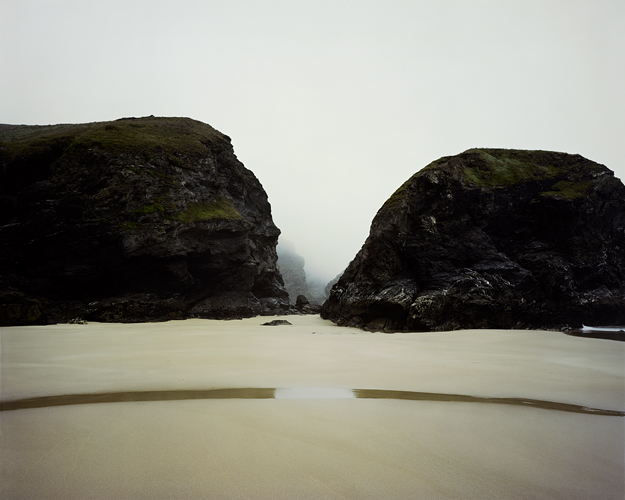
White Hinterland - "Baby". Anyone who has watched the sea for long enough knows that it is unsentimental. Forget the lapping surf and the perfect sunsets - this is an expanse of churn and thrash, ungoverned violence. It could drown you or carry you, lift or fall away; it could rise like a wall or seem to vanish, mirrored, in the afternoon light. Don't fuck with it, this grey, blue, green, silver, indigo force; nor, "Baby" suggests, with Casey Dienel's grey, blue, green, gold, pink, clear heart. On Baby, White Hinterland's music is crashing and unkind R&B; I've long loved Dienel's vocal trills, her undersung hooks, but here she pants like a tide and groans like a pipe-organ. She's noisy cacophony, retching love. She's club-drunk and bedroom-hungry, choirgirl and part-harpy. This album is a hardship, in a way; it's heavy as hell, unabating. It demands to be reckoned with. But you listen to the hoarse closing seconds of this title track, Dienel's bare broken breath, and you are reminded of what's at stake with these gestures - this monstrousness is music, this hardship's a singing, these currents of voice and beats, eros and fury, are an artist's bare work. Forget the question of whether the sea is beautiful or ugly; remember only that it is coming for what it wants, and always will be. [buy / White Hinterland plays Montreal on Friday, April 18]
(photo by Guy Sargent)
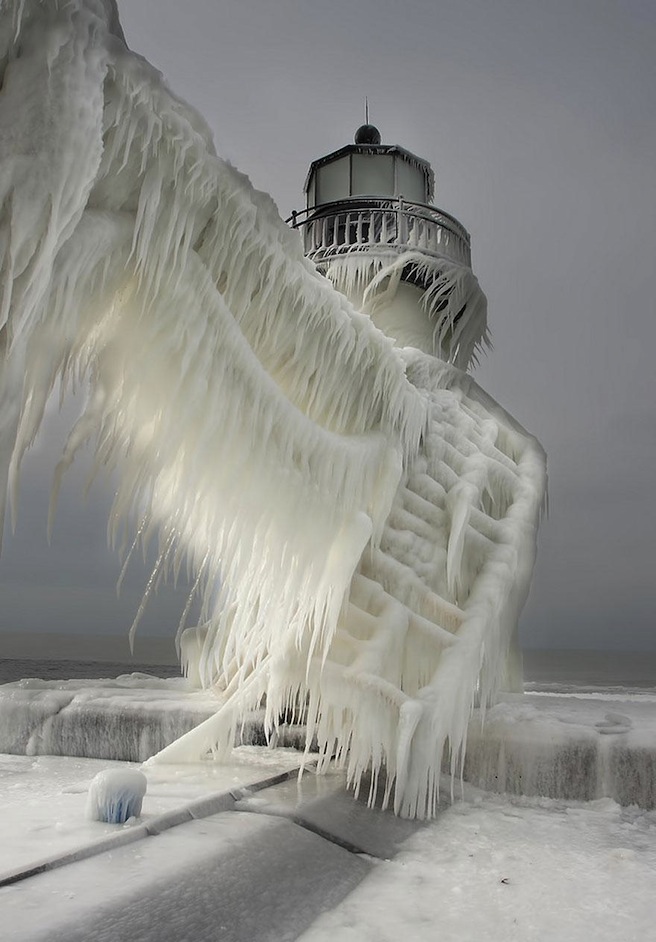
Will Stratton - "Gray Lodge Wisdom (ft the Weather Station)". A long gleam interrupted by shorter gleams; a morse code of gleams; a smouldering coal and twenty lightning-bolts. At brunch on Saturday we looked at the plate of cream-filled éclairs and remembered that éclair also means lightning bolt. "Gray Lodge Wisdom" is a languorous song fettered by quick fiddles and some kinda dulcimer, and by Tamara Worden's slow coal voice, and by a thousand éclairs - comforts and lightning-bolts - come to the door as parcels, wrapped in brown paper. It gestures toward wisdom like a skater skating toward a distant point, knowing he could fall. Stratton owns a pair of mittens but here his hands are bare.
[buy / Gray Lodge Wisdom will be celebrated at a New York record release show, April 16 at Brooklyn's Union Hall]
(photo source)
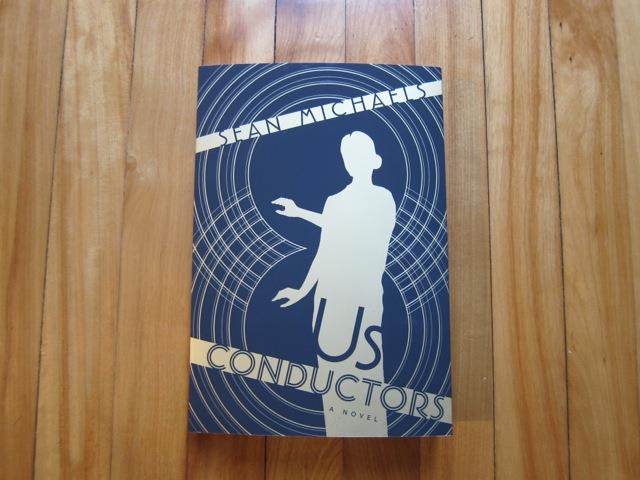
Today my first novel, Us Conductors, is published all across Canada. I won't be bothering you like this again until it is published in the United States in June. But I wanted to make sure you heard, you out there, old friends and kindred spirits and trespassers who strayed onto this blog looking for "girl legs" or "shi poem". Us Conductors is published by Random House of Canada, and you can order it via its website, or buy it in shops, or on iBooks or in kindletown, or you can come into my front garden and when spring comes I will sit out there with you and try to persuade you to buy it.
Us Conductors is a kind of love story about Lev Sergeyvich Termen, inventor of the theremin, and Clara Rockmore, its greatest player. It's a novel about invention, memory, debt, airships, orchestras, Soviet spies, American ballerinas, Siberian taiga, electric singing, killer kung-fu, blue speakeasies, and responsibility. It's full of lie-seeming truths and true-feeling lies.
I started writing this book in 2009. Its working title was IN WHICH I WIN THE LOVE OF CLARA ROCKMORE, MY ONE TRUE LOVE, FINEST THEREMIN PLAYER THE WORLD WILL EVER KNOW. The book begins with an epigraph by Tennessee Wiliams: "In memory, everything seems to happen to music." There are chapters about the 1929 Crash and the the day Lenin played the theremin. The chapter titles are taken from songs by artists like Kate Bush, Jesus & Mary Chain, and Mark Hollis. There are a few gramophones, but they don't say anything.
Besides tracks by Tim Hecker and the Cocteau Twins, the piece of music that most impacted this book was Clara Rockmore's 1977 performance of Saint-Saëns' "The Swan" (accompanied by her sister, Nadia). It was recorded when Rockmore was in her sixties, well after the events fictionalized in Us Conductors.
Listen to it here: Clara Rockmore - "The Swan (Saint-Saëns)".
I am so tired after a busy few days and so for now all that I will say is: I hope you will buy this book, and maybe come to see me if I visit the place where you live. To learn of book tour dates, subscribe to my newsletter or up-up my Facebook whozit or Twitter whatsit, or just keep reading this site.
Over the next month I will be visiting the Ottawa Writers Fest, talking with Socalled as part of Blue Metropolis, and also hosting a very special Montreal book launch on April 24. But now and foremost, if you dwell in Toronto: please come tonight, Tuesday, April 8, as I launch Us Conductors at your Monarch Tavern. I have the honour of sharing this celebration with Carl Wilson, who launches an expanded version of Let's Talk About Love, one of my favourite books. And we will be joined by wonderful, generous friends: Said the Gramophone's own Daniel Beirne, rapp-battlezin' versus Roger Bainbridge; the thereminist Jeff Bird, playing solo and accompanying the band Snowblink; the writer Liisa Ladouceur; and our splendid DJ, the one and only Sandro Perri. I hope you can join us.

Nap Eyes - "No Fear of Hellfire".
Nap Eyes - "The Night of the First Show".
Nap Eyes' Whine of the Mystic is a ragged splendour, one of the best things in ages. A band from Halifax with a sound like young caterpillar and old silk, like the Velvet Underground and Electrelane and Destroyer and Guided by Voices. Like liking a drink you know isn't good for you; that's good for you, that's good for you, that you know isn't good for you.
Or a man that's (not) good for you, or a place. Music as simple as Nap Eyes' seems adaptable to many metaphors. Like a towel, like a gun, like a US treasury bond - you could use this in lots of different ways. They are a rock band just so faintly tripping. They are priests of Shaolin and the Holy See, with electric guitars in their hands, with an un-fancy drum-kit. When I finally saw them live they didn't look like they much; but I noticed the white and silver highlights on their instruments, the white and silver highlights of their lightly shearing songs.
"No Fear of Hellfire" is a meditation, "The Night of the First Show" is a shaggy recollection. Two flavours of spring ice. (Ice as in British ices: popsicles, creamsicles; not April's cold streaks.) The first song canters, the second rollicks. One tells a story, one tells much less of a story. One is lemon-sour and one is cherry-sweet; I'll let you choose which is which. Nap Eyes' songs are mazey and riddled, but ambivalent about their mazes, ambivalent about their riddles; in this way they remind me of good smoke, holy incense smoke, always true to its incantation.
---
Elsewhere:
A reminder that I'm all over Toronto this coming week, promoting Us Conductors. On Saturday, join me at Spur Festival's Literary Cabaret, where I'll talk about Siberia as part of an evening featuring dark & hilarious MCs Miguel and Freddie Rivas, writers Cecil Foster and Hillary Rexe, thereminist Clara Venice, etc; on Sunday, a more in-depth Books & Brunch event, where I'll read from and discuss my novel; finally on Tuesday night, Carl Wilson and I are staging a dual book launch at the Monarch Tavern. We've just added DJ Sandro Perri to the bill, but more on that next week.
I wrote about Us Conductors' beginnings - discovering the theremin, researching the novel - for Quill & Quire.
And for the 49th Shelf I wrote an essay about some of New York's extraordinary (real-life) nightclubs of the 1920s and 1930s - barbecue, pirates and snowball-fights.
Us Conductors was chosen by Apple iBooks as one of April's 10 best fiction books. It's available in Canada as of April 8.
(photo source unknown)
|
about said the gramophone
This is a daily sampler of really good songs. All tracks are posted out of love. Please go out and buy the records.
To hear a song in your browser, click the  and it will begin playing. All songs are also available to download: just right-click the link and choose 'Save as...'
All songs are removed within a few weeks of posting.
Said the Gramophone launched in March 2003, and added songs in November of that year. It was one of the world's first mp3blogs.
If you would like to say hello, find out our mailing addresses or invite us to shows, please get in touch:
Montreal, Canada: Sean
Toronto, Canada: Emma
Montreal, Canada: Jeff
Montreal, Canada: Mitz
Please don't send us emails with tons of huge attachments; if emailing a bunch of mp3s etc, send us a link to download them. We are not interested in streaming widgets like soundcloud: Said the Gramophone posts are always accompanied by MP3s.
If you are the copyright holder of any song posted here, please contact us if you would like the song taken down early. Please do not direct link to any of these tracks. Please love and wonder.
"And I shall watch the ferry-boats / and they'll get high on a bluer ocean / against tomorrow's sky / and I will never grow so old again."
about the authors
Sean Michaels is the founder of Said the Gramophone. He is a writer, critic and author of the theremin novel Us Conductors. Follow him on Twitter or reach him by email here. Click here to browse his posts.
Emma Healey writes poems and essays in Toronto. She joined Said the Gramophone in 2015. This is her website and email her here.
Jeff Miller is a Montreal-based writer and zinemaker. He is the author of Ghost Pine: All Stories True and a bunch of other stories. He joined Said the Gramophone in 2015. Say hello on Twitter or email.
Mitz Takahashi is originally from Osaka, Japan who now lives and works as a furniture designer/maker in Montreal. English is not his first language so please forgive his glamour grammar mistakes. He is trying. He joined Said the Gramophone in 2015. Reach him by email here.
Site design and header typography by Neale McDavitt-Van Fleet. The header graphic is randomized: this one is by Neale McDavitt-van Fleet.
PAST AUTHORS
Dan Beirne wrote regularly for Said the Gramophone from August 2004 to December 2014. He is an actor and writer living in Toronto. Any claim he makes about his life on here is probably untrue. Click here to browse his posts. Email him here.
Jordan Himelfarb wrote for Said the Gramophone from November 2004 to March 2012. He lives in Toronto. He is an opinion editor at the Toronto Star. Click here to browse his posts. Email him here.
our patrons
search
Archives
elsewhere
our favourite blogs
(◊ means they write about music)
Back to the World
La Blogothèque ◊
Weird Canada ◊
Destination: Out ◊
Endless Banquet
A Grammar (Nitsuh Abebe) ◊
Ill Doctrine ◊
A London Salmagundi
Dau.pe ◊
Words and Music ◊
Petites planètes ◊
Gorilla vs Bear ◊
Herohill ◊
Silent Shout ◊
Clouds of Evil ◊
The Dolby Apposition ◊
Awesome Tapes from Africa ◊
Molars ◊
Daytrotter ◊
Matana Roberts ◊
Pitchfork Reviews Reviews ◊
i like you [podcast]
Musicophilia ◊
Anagramatron
Nicola Meighan ◊
Fluxblog ◊
radiolab [podcast]
CKUT Music ◊
plethoric pundrigrions
Wattled Smoky Honeyeater ◊
The Clear-Minded Creative
Torture Garden ◊
LPWTF? ◊
Passion of the Weiss ◊
Juan and Only ◊
Horses Think
White Hotel
Then Play Long (Marcello Carlin) ◊
Uno Moralez
Coming Up For Air (Matt Forsythe)
ftrain
my love for you is a stampede of horses
It's Nice That
Marathonpacks ◊
Song, by Toad ◊
In FocusAMASS BLOG
Inventory
Waxy
WTF [podcast]
Masalacism ◊
The Rest is Noise (Alex Ross) ◊
Goldkicks ◊
My Daguerreotype Boyfriend
The Hood Internet ◊
things we like in Montreal
eat:
st-viateur bagel
café olimpico
Euro-Deli Batory
le pick up
lawrence
kem coba
le couteau
au pied de cochon
mamie clafoutis
tourtière australienne
chez boris
ripples
alati caserta
vices & versa
+ paltoquet, cocoa locale, idée fixe, patati patata, the sparrow, pho tay ho, qin hua dumplings, café italia, hung phat banh mi, caffé san simeon, meu-meu, pho lien, romodos, patisserie guillaume, patisserie rhubarbe, kazu, lallouz, maison du nord, cuisine szechuan &c
shop:
phonopolis
drawn + quarterly
+ bottines &c
shows:
casa + sala + the hotel
blue skies turn black
montreal improv theatre
passovah productions
le cagibi
cinema du parc
pop pmontreal
yoga teacher Thea Metcalfe
(maga)zines
Cult Montreal
The Believer
The Morning News
McSweeney's
State
The Skinny
community
ILX
|