Viking Moses - "Sandstorms". A song for what Viking Moses had. A stamp he licks and places on an envelope. He must have worked for weeks, for whole weeks, writing, composing, shaping this song. And somehow he found it, just right he found it. One night he was finally finished and he could put it on the turntable and listen, headphones on ears, wood-shavings at his feet. A song to mark what he had. A stamp he licks and places on an envelope. A lesson in reverb. When the piano comes back, at the end, my heart breaks every time. A song that begins down, below a lover's navel. A song that ends very far from that place. A stamp he licks and places on an envelope. A song for what Viking Moses had.
[MySpace]
---
Eleanor Meredith, she of the fairly recent guestpost, now has an online shop where you can buy prints of some of her lovely, whimsical artworks.
Katie Dill - "The Body's Only Rental". It's the way of girls with ukeleles, I think; there's something inherent in them. Katie's voice is lake-pretty and her uke sends up long struts of shine. The reverb's like a sunlight that won't leave yr room, even after dark. I wake up with the song stuck in my head. Yesterday I sang it out loud in a chapel 100 metres underground. But the thing that catches me, more and more, is the words. By now I'm used to the song's general loveliness (I'd even be tempted to call it "mere" loveliness, absurdly, like true loveliness can ever be mere. [If you believe loveliness is mere, clearly you have never sat and watched Krakow's market square on that first, early, day of summer.]) -- but Dill's rhymes and repetition, the way they're at once easy (i.e. almost trite) and strange (i.e. unexpected), well "The Body's Only Rental" keeps bringing me to motionless silence during late nights or when the sun is high, or any time, really, even running along the Wisla River. "My life is full of gentle," she sings, and if she was singing "My life is full of gentleness" I'd pay no heed at all, but "gentle", yes, "gentle"; "gentle" as a noun; this is bent in a way that to me is pure poetry. And the way she later rhymes "water", "harder" and "water" again: I mean it, I really do, that this is to me a choice all full of rightness and beauty. And the song's greater message, this holistic, almost karmic stuff; well it's like the Salinger stories I was reading, weeks ago: Seymour's reassuring buddhist certainties. His gentle. Or the way Salinger can write "I think love is a touch and yet not a touch", and me I don't imagine the inside of a greeting card -- I feel my whole world give a little tremble.
Anyway, look, "The Body's Only Rental" is one of my favourite songs of the year so far, and maybe I say that a lot, but it's true, even if you can't really dance to it, and if I had a hand-tailored suit I'd keep it for a while in my inside pocket, where it would stay warm.
[Katie at MySpace]
---
Elsewhere... (all three of these are a little late-to-press, but I've not had the chance before now):
Tuwa's post on Cypress Hill is personal and wide-ranging and another one of these examples of how musicblogging, as a medium, can be something pretty special. Do read it.
A recent post at Shake Your Fist thankfully abandons the subject of a band called Seamonster and spends its last paragraphs on Neutral Milk Hotel. This wouldn't bear remarking except that Amy's writing on Jeff Magnum is beautifully right-on ("that wobbly steel-bowled voice") and her look at NMH-and-sex, while succinct, is as insightful as anything I've read on Aeroplane Over the Sea.
My Paste feature on Arcade Fire is now up on their website. It's an interview/studio visit thing, and I'm not altogether happy with it, but there's some good & true moments, too. Much, much better (and the best profile I've ever seen of the band), is Darcy Frey's piece for the NY Times magazine.
Rachell Sumpter's new show has opened at the Richard Heller Gallery, and the paintings are once again revelatory. There's something in her work that stirs me in all my dryest, worn out places: hope and wonder and mystery, searching and finding, magic and steamed breath and smoky hot human touch. If I had $2,000 to spend on a painting, there is no doubt in my mind how I would spend it. (See also Rachell's StG guestpost, ages back.)
Last week, Jean Baudrillard finally returned my email. Months ago I wrote to him, inviting him to contribute to our Said the Guests series, to take some moments and write about a couple favourite songs. It is not an exaggeration (though it is a metaphor) to say than in my first years at McGill University, Baudrillard's writings blew my mind. His work on culture, politics, language and technology had an enormous impact on critical theory in the latter half of the 20th c, and I wasn't the first kid to find himself mesmerised by these ideas.
Of course it's a busy life being an eminence grise of post-structuralism; I wasn't surprised that Mr Baudrillard did not at first return my unsolicited letter. (I still haven't heard back from McLuhan, Foucault, Deleuze or Guattari.) But imagine my delight last Sunday when my mail program went bing-bong and Jean Baudrillard's name appeared in the email byline. "I found myself with some temps libre :*)", he wrote. And so without further ado, in the man's own words...
These songs, each of which has a good tune and rhythm, are entirely unproblematic.
Non, c'est seulement une petite blague pour un petit blog.
Avril Lavigne - "Complicated"
In actual fact, the songs all call to mind the philosophical aphorism ex nihilio nihil fit (nothing comes from nothing). Of this phrase there can be a certain kind of understanding that amounts to not much more than a non-understanding, but constitutes, in fact, the only multi-dimensional interpretation of the maxim as it pertains to what we call the real. This is the non-understanding of Parmenides; a paradoxical cognizance, which appears untenable because it leads to "absurd" consequences, and is the opposite of the Understanding of Bertrand Russell, which obliterates the soundness of the proposition through obfuscatory clarity1. Now, I don't mean to bore you (or myself) with philosophical exercises - I raise this only as an attempt to explain how this song can exist and not exist at once. In truth, Avril Lavigne is nothing emergent from nothing, which is to say she is merely the simulacrum of a simulacrum, two orders shy of real2.
It is obvious enough that Lavigne's insouciant attitude, punk-inspired fashion choices, and nihilistic antics are meant to represent rebellion, yet are firmly entrenched in the vapid mainstream against which she proudly rebels. That she is a fraud is trivial, of course. What's more, when we listen to her song on a CD or mp3 player, or sitting in front of our computer, with headphones on, reading the writings of one Jean Baudrillard; we are not hearing her, or her rebellion, but a simulation of her simulation in which Lavigne, her song, and her pretend rebellion all cease to be manifest. At the same time precisely, however, all that ceases to be takes on a new kind of being, that of the hyperreality of what it fraudulently represents: rebellion. The listener/viewer is presented with the encoded simulations of "Complicated" (both auditory and visual) as "real" rebellion and, if credulous enough (as is often the case), understands it as such. Thus the song is adopted as the model of the phenomenon. Its rebellion is real; Lavigne is no fraud. From the Matrix emerges a new rebellion in place of the old.
(I find the last line of "Complicated" ("Honestly, promise me I'm never gonna find you fake it") - with its implication of prescribed "realness" - funny on SO MANY LEVELS.)
All of the above could be said of this, too.
Lead Belly - "(Good Night) Irene"
Throughout his life, John Lomax sought out the real music of America and found it as much as anywhere in the extensive songbook of Huddie Leadbetter. Leadbetter was as real as a sphere is equally tall in all directions: He was a lowlife; an unrepentant sinner and a murderer. He won more gunfights than he lost but was so often shot in the stomach that he earned the nickname "Lead Belly." He was a gentleman and a gentle man; he wouldn't hurt a fly. He was misunderstood and depressed and drank himself to death, though his tolerance for alcohol consumption was so impressive it earned him the nickname "Lead Belly." Lomax had him released from a prison in which he was never incarcerated for a murder he was guilty of but did not commit, so that he could compose songs (make them real), perform songs (make them real), and record songs (make them real); so that his own realness could persist and intensify in communications from well beyond the conclusion of the flimsiest, most ephemeral dimension of his existence.
Footnotes:
- Russell wants to show us that we mean by ex nihilio nihil fit not that there is something that has the property of non-existence that comes to be from nothing, but that it is not the case that there exists some y such that if there does not exist an x, then that y can come from that x. Bullshit!
- She is three orders shy of real!
[Jean Baudrillard died on March 6, 2007.]
(Previous guest-blogs: artist Danny Zabbal, artist Irina Troitskaya, artist Eleanor Meredith, artist Keith Greiman, artist Matthew Feyld, The Weakerthans, Parenthetical Girls, artist Daria Tessler, Clem Snide, Marcello Carlin, Beirut, Jonathan Lethem, Will Butler (Arcade Fire), Al Kratina, Eugene Mirman, artist Dave Bailey, Agent Simple, artist Keith Andrew Shore, Owen Ashworth (Casiotone for the Painfully Alone), artist Kit Malo with Alden Penner (The Unicorns) 1 2, artist Rachell Sumpter, artist Katy Horan 1 2, David Barclay (The Diskettes), artist Drew Heffron, Carl Wilson, artist Tim Moore, Michael Nau (Page France), Devin Davis, Will Sheff (Okkervil River), Edward Droste (Grizzly Bear), Hello Saferide, Damon Krukowski (Damon & Naomi), Brian Michael Roff, Howard Bilerman (producer: Silver Mt. Zion, Arcade Fire, etc.). There are many more to come.)
Department of Eagles - "No One Does It Like You". A new track by Department of Eagles, Grizzly Bear's terrific sibling band, something that is to my ears a song of infidelity - and yet so deliciously laid back, so warm and easy, so calm & affectionate that it's hard to find even a lick of frustration. Like Grizzly Bear's cover of "He Hit Me (And It Felt Like A Kiss)" (posted last week), "No One Does It..." was inspired by the ridiculously cheap Phil Spector Back to Mono box-set. But although "No One"'s got a modest Wall of Sound, all jingle, clap & whistle, the doo-wop chain-gang reminds me mostly of The Inkspots, facing melancholy with a smile.
[more of the Dept of Eagles]
Avril Lavigne - "Hot". I'm always a little wary of power chords. They're like firebombs, binoculars, high tens: they need to be used judiciously, only with the most appropriate of ends. Avril's usage is not just appropriate, it's wholly righteous. Here's a song about kick-ass love, about oh-yes love, like running for three hundred years in order to build up momentum for one enormous long-distance leap, straight into a beloved's arms. It's a jubilant, Evel Knievel kind of love, with a chorus that justifies whatever weaponry it can get. "You make me so hot / you make me want to drop / you're so ridiculous / I can barely stop / I can hardly breathe / you make me want to scream / you're so fabulous / you're so good to me!" And while obviously the lyrics are secondary, an adolescent articulation of something deep, majestic, chest-and-belly, I do admire one of these plain lines. "You're so ridiculous," she sings, with an affection that's almost desperate, and this is a statement that feels true & real and so familiar to how I feel, yeah me right here, when I sweat with love's hottest fevers.
Like "Umbrella" or "Crazy in Love", "Hot" is a declamatory (or maybe exclamatory) song. In rock and folk music, the trend among love-songs is usually to serenade, to win someone's love or else to whisper private truths about why they're so dear. "Hot" uses another model: it's a heart icon and an exclamation mark, an adoring shout, a public celebration of one particular love. (It's the valentine that trails a jetplane.)
The Best Damn Thing makes Avril Lavigne 3 for 3 - maybe the best stats in pop-punk? (And "Girlfriend"'s amazing.) [buy]
---
Elsewhere:
It's Avril Lavigne Day - Fluxblog's writing about "The Best Damn Thing", and while you're there grab the great Half-Cousin song, too.
Tuwa's unkind to Bill & Ted's Excellent Adventure. :(
Rihanna ft. Jay-Z - "Umbrella". After the relative off-year of 2006, this, Amy Winehouse, and Amerie's "Gotta Work" show that pop in 2007 is back, back, back. (Maybe the new Avril single applies as well but - !?!!! - I haven't heard it yet.) With its crisp drum break "Umbrella" is post-"1 Thing"; with its alt-rock r&b it's post-"Since U Been Gone"; with its "umbrella / ella / ella / ay ay / ay" it's even post-MIA. More weirdly however, there's something almost post-rock about "Umbrella" -- it's ripe not just for indie-rock covers, but for takes by the po-faced likes of Explosions in the Sky or Mono. Despite Jay-Z's giddy intro, the song's not in the least bit light: it's serious, sincere, full of promises and forevers. "Crazy in Love" had a similar weight but here nobody's singing about infatuation, new love - Rihanna's singing about certain love, alwayses, literally the weathering of storms. The lyrics are heavy: "You're part of my entity / yeah, for infinity." Not a track for the first date, or the second; probably more suited for a diamond anniversary (Jay-Z: "No clouds in my stones." / Rihanna: "Took an oath, gonna stick it out til the end.") It's dark, droning, forceful (and yet totally summer-boombox awesome). Sean's promise: By the fourth time you hear it you will understand that it is amazing.
Or, said another way:
For two and a half weeks they had been fighting. Little things - he arrived late for breakfast; she forgot to check her email for the name of that band; he let the spaghetti sauce splatter all over the stove; a waiter was rude and she was rude back even though she "didn't have to sink to his level". It's what at one time would have been called "squabbling" but today, in this day & age or maybe just today, was called fighting. Elsa and Jamie had been fighting. It was Wednesday and they had last been together on Monday night, at a play, where she had given a standing ovation and he had not.
Elsa had not slept - as Tuesday became Wednesday she lay wide-eyed in her sheets, listening to the rain that stopped-started outside the window. Street lights flashed through the curtains and she just wanted to close her eyes and fall asleep. She couldn't. She buried her head under her pillow; she curled her feet to her chest; she stretched out and drummed her heels against the mattress. She wanted to sleep. She kept thinking about Jamie, trying not to think about Jamie; she kept thinking about Jamie and trying not to think about him.
In the morning she sat in her kitchen and felt grey, dusty, worn. She drank a glass of stale water and then refilled it from the tap. She sighed. And the glass broke in her hand. She leapt to her feet and brushed the shards from her palm into the garbage bin. She was thinking: I wonder what Jamie would say. She sopped up the water with paper towels and collected the pieces of glass from the table. "Fuck," she said, but only after she had finished tidying everything up.
She went to work and looked at her computer screen and typed and at 10:40 she went into the staff-room and filled a mug with water from the water-cooler.
"How're things?" said Mirabel.
"Good," said Elsa.
"You and Jamie should come over for dinner on Saturday."
"That would be nice." Elsa looked at the mug. It was earthenware, blue and gold. She imagined it shattering in her hand. And then it did.
"Jesus!" said Mirabel.
---
Elsa broke one more mug that morning, then a water-bottle at lunch, then a plastic cup in the afternoon. When she got home after work she broke two glasses - one short, one tall. And listen, she never meant to break any of them. They just came apart. She wasn't squeezing them til they shattered, she wasn't having an involuntary spasm. Glasses, bottles, mugs, everything was just coming to pieces when she touched it.
She called Jamie.
"Hi," she said.
"Hi," he said.
"How's it going?" she asked.
"Fine," he answered. "How are you?"
And she told him about the glasses, about how everything was breaking all the time, water always dripping from the ends of her fingers. And he said "Oh no! Elsa, are you okay? Are you okay?" and she said "I'm okay," and he said "Should we go see a doctor, or a specialist, or a scientist or something? Figure out what's going on?" And she heard the way he said "we".
"No," she said, "just come over, Jamie. I love you so much. Please just come over. All I want is for you to come over."
"We'll hold glasses together," he said. "Let 'em shatter."
"Let 'em shatter," she said. "Come over."
---
[Rihanna's homepage]
Today I want to talk about three things that come to me by way of the sporadic but often excellent Grizzly Bear Blog. (This is the blog of the rock-band Grizzly Bear and not, unfortunately I admit, a blog about grizzly bears.)
The Crystals - "He Hit Me (And It Felt Like A Kiss)"
Grizzly Bear - "He Hit Me (And It Felt Like A Kiss)" [live on KEXP]
This is (i think) the first song that we have ever posted (i hope) which is in at least some ways a celebration of domestic abuse. The creators might claim it takes place in extenuating circumstances: the singer's been "untrue" and so when the partner takes a swing it's 'proof' he loves her. "If he didn't care for me / I could have never made him mad / but he hit me / and I was glad."
I'm not an apologist for the song - especially in the context of a girl-group like The Crystals, singing a song written for them by others (even if one of those others was Carole King!). But more interesting than this familiar critique is an exploration of the song's deeper tension, there in the distressed wall of sound that swings between Handel's Messiah and a prison march. If there's a question at the heart of this song then the answer is S&M - and not just in the cludgy, misogynistic "violence is sexy" way. Yes, the track's chorus & title are swathed in pretty, pretty instrumentation, the violence made beautiful in strings and coos. But there's also the taste of a correllary: not just roughness as love... love as roughness. Hear it in the final, triumphant line: "And when he kissed me / he made me hiss."
When Grizzly Bear take on the tune they play with precisely the same flavours. It's a more complicated reading - it's a band of men! and they're queer! - but still the voices weave in a near-hallelujah chorus, and still something sharp stalks in even the tenderest moments (hear that electric guitar, hear the brisk roll of snare).
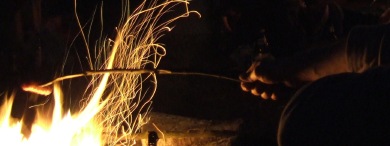
Magic Arm - "Outdoor Games". If you could pack a fireside into a backpack, carry it with you on all your adventures, this might be how it would sound. Stop on the New Mexico highway; unpack your fireside. Pause in the English heath; unpack your fireside. Stomp through the Siberian snow; unpack your fireside. There's warmth and friendship and sweet liquors, here. There's acoustic guitar, synths, piano, hand-sounds, harmonica. There's spiced blending voices, the stuff of The Beta Band, Sleeping States, Akron/Family, Grizzly Bear, or even The Bees. There's a question over and over: "Do you have the will to end?". It's an odd question in a song as kind as this. Why make that dare? Why ask people to answer that? Unless it doesn't mean what it might. Unless it's not "Do you have the will to end [it]?" and instead, friends, "Do you have the will to [make it to the] end?"
Do you? I do.
[MySpace]
John Convertino - "When Mass Was Said In Latin". Everything, when rung, resounds. Some things resound longer than others (piano-strings, alarm clocks, heartbreaks). But all things do resound for a time. And so listening to this track, an instrumental by the man who usually plays drums in Calexico (and at one time for Giant Sand), I must ask: these are bells, right? They're not rib-bones, or river-stones? They're not regrets, or wants, or lost homes? Occam's Razor says bells but I have to ask, I have to ask. There's definitely something with the piano here, making those wide choral sounds - a track as fine as any Rachel's have recently recorded. There's definitely something with the piano here; bells, maybe. Or years. Years, rung.
[buy Ragland]
Buck 65 - "Centaur (Acoustic Version)". Buck 65 steps to the plate. He don't pull no punches. He looks the subject-matter square in the midsection and then does what needs to be done. He takes the voice of the Centaur, that mythical man-horse; he struts through the city; and he notes what you're all lookin' at. Yes the centaur is "drastically endowed", "crotchety in more ways than one". He won't pretend he's not. Over day-in-the-life acoustic guitar, wheezy organ and a little thumb-piano, he admits it, he admits everything. He doesn't ask for sympathy but just for people to maybe get over it. "Way out of proportion / My heart is the warmest / unfortunately for me my private part is enormous."
[buy This Right Here Is]
---
Still thinking of going to the Dirty Three-curated ATP? Three of us need a fourth person to fill out our chalet. Email me!
---
Elsewhere:
Caketrain Press is publishing Dolls, a chapbook of prose poetry by Todd Whalen. It looks like something special - and has cover art by our friend Matthew Feyld.
And the inimitable, remarkable mp3blog Moistworks is once again holding a Writers Week, with words-on-music by the authors Dana Spiotta, Jenny Offill, Rick Moody, Christopher Sorrentino and Susan Choi.
|
about said the gramophone
This is a daily sampler of really good songs. All tracks are posted out of love. Please go out and buy the records.
To hear a song in your browser, click the  and it will begin playing. All songs are also available to download: just right-click the link and choose 'Save as...'
All songs are removed within a few weeks of posting.
Said the Gramophone launched in March 2003, and added songs in November of that year. It was one of the world's first mp3blogs.
If you would like to say hello, find out our mailing addresses or invite us to shows, please get in touch:
Montreal, Canada: Sean
Toronto, Canada: Emma
Montreal, Canada: Jeff
Montreal, Canada: Mitz
Please don't send us emails with tons of huge attachments; if emailing a bunch of mp3s etc, send us a link to download them. We are not interested in streaming widgets like soundcloud: Said the Gramophone posts are always accompanied by MP3s.
If you are the copyright holder of any song posted here, please contact us if you would like the song taken down early. Please do not direct link to any of these tracks. Please love and wonder.
"And I shall watch the ferry-boats / and they'll get high on a bluer ocean / against tomorrow's sky / and I will never grow so old again."
about the authors
Sean Michaels is the founder of Said the Gramophone. He is a writer, critic and author of the theremin novel Us Conductors. Follow him on Twitter or reach him by email here. Click here to browse his posts.
Emma Healey writes poems and essays in Toronto. She joined Said the Gramophone in 2015. This is her website and email her here.
Jeff Miller is a Montreal-based writer and zinemaker. He is the author of Ghost Pine: All Stories True and a bunch of other stories. He joined Said the Gramophone in 2015. Say hello on Twitter or email.
Mitz Takahashi is originally from Osaka, Japan who now lives and works as a furniture designer/maker in Montreal. English is not his first language so please forgive his glamour grammar mistakes. He is trying. He joined Said the Gramophone in 2015. Reach him by email here.
Site design and header typography by Neale McDavitt-Van Fleet. The header graphic is randomized: this one is by Danny Zabbal.
PAST AUTHORS
Dan Beirne wrote regularly for Said the Gramophone from August 2004 to December 2014. He is an actor and writer living in Toronto. Any claim he makes about his life on here is probably untrue. Click here to browse his posts. Email him here.
Jordan Himelfarb wrote for Said the Gramophone from November 2004 to March 2012. He lives in Toronto. He is an opinion editor at the Toronto Star. Click here to browse his posts. Email him here.
our patrons
search
Archives
elsewhere
our favourite blogs
(◊ means they write about music)
Back to the World
La Blogothèque ◊
Weird Canada ◊
Destination: Out ◊
Endless Banquet
A Grammar (Nitsuh Abebe) ◊
Ill Doctrine ◊
A London Salmagundi
Dau.pe ◊
Words and Music ◊
Petites planètes ◊
Gorilla vs Bear ◊
Herohill ◊
Silent Shout ◊
Clouds of Evil ◊
The Dolby Apposition ◊
Awesome Tapes from Africa ◊
Molars ◊
Daytrotter ◊
Matana Roberts ◊
Pitchfork Reviews Reviews ◊
i like you [podcast]
Musicophilia ◊
Anagramatron
Nicola Meighan ◊
Fluxblog ◊
radiolab [podcast]
CKUT Music ◊
plethoric pundrigrions
Wattled Smoky Honeyeater ◊
The Clear-Minded Creative
Torture Garden ◊
LPWTF? ◊
Passion of the Weiss ◊
Juan and Only ◊
Horses Think
White Hotel
Then Play Long (Marcello Carlin) ◊
Uno Moralez
Coming Up For Air (Matt Forsythe)
ftrain
my love for you is a stampede of horses
It's Nice That
Marathonpacks ◊
Song, by Toad ◊
In FocusAMASS BLOG
Inventory
Waxy
WTF [podcast]
Masalacism ◊
The Rest is Noise (Alex Ross) ◊
Goldkicks ◊
My Daguerreotype Boyfriend
The Hood Internet ◊
things we like in Montreal
eat:
st-viateur bagel
café olimpico
Euro-Deli Batory
le pick up
lawrence
kem coba
le couteau
au pied de cochon
mamie clafoutis
tourtière australienne
chez boris
ripples
alati caserta
vices & versa
+ paltoquet, cocoa locale, idée fixe, patati patata, the sparrow, pho tay ho, qin hua dumplings, café italia, hung phat banh mi, caffé san simeon, meu-meu, pho lien, romodos, patisserie guillaume, patisserie rhubarbe, kazu, lallouz, maison du nord, cuisine szechuan &c
shop:
phonopolis
drawn + quarterly
+ bottines &c
shows:
casa + sala + the hotel
blue skies turn black
montreal improv theatre
passovah productions
le cagibi
cinema du parc
pop pmontreal
yoga teacher Thea Metcalfe
(maga)zines
Cult Montreal
The Believer
The Morning News
McSweeney's
State
The Skinny
community
ILX
|



Sean,
I read nothing but bones in this post and Dan's previous. Skin is only there for creams and eyeshadows, anyway.
Beautiful as always.
A.